


 ASTRO SWISS KNIFE
3/4
ASTRO SWISS KNIFE

Capture requires having a camera and/or a photographic device. Here I propose the design of tables dedicated to the capture equipment
in your possession. To begin, a sensor chart allowing to know the stellar field per pixel in arc seconds indicating the sampling according
to the focal length of the optical instrument. This chart was attached in the "download of files" on the previous page "DEEP SKY OBJECTS".
Easy to use, it does not require comments.
| Calculation of sampling | = 206 x Pixel size in µ / Optical focal length. |
| Calculation of the photographic field | = (180/PI) x (Width mm or Height mm / Focal length) |
| 2nd formula by rounding | = 57.3 x (Width mm or Height mm / Focal length) |
| Calculation by sampling | = sampling x Number of Pixels |
| Example: | |
| Canon 300D | |
| sensor size - Width x Height | = 22.70mm x 15.10mm - 3072px x 2048px |
| pixel size | = 7.4µ |
| WO FLT 132 SCOPE | |
| Optical focal length | = 924mm. |
| Sampling | = 206 x 7.4 /924 = 1.65" |
| Photographic Field Width. Sensor | = (180/PI) x (22.7/924) = 1.41° |
| = 57.3 x (22.7/924) = 1.41° | |
| = 1.65 x 3072 = 1.41° | |
| Photographic Field Height. Sensor | = (180/PI) x (15.1/924) = 0.94° |
| = 57.3 x (15.1/924) = 0.94° | |
| = 1.65 x 2048 = 0.94° |
- Sensor chart by size to choose the focal length needed depending on the objects to be imaged.
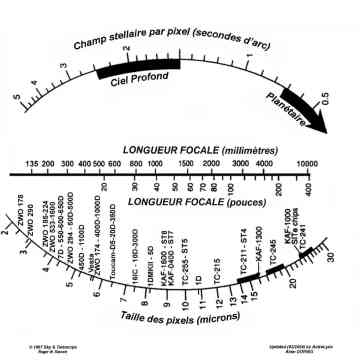
The Star Field / Focal Length / Pixel Size chart.
Below is a non-exhaustive series giving an overview of the possible sensor tables.
Click on the "SENSOR CHOICE" button below to download the EXCEL table.
Place this file in a directory (folder) of your choice, launch it and accept the macros to activate the "Export" button.
At the top of the table, click on the drop-down menu, scroll through the list of 175 available sensors
using the PgDn and PgUp keys on the keyboard and choose your sensor.
Once chosen, the left column offers pre-selected focal lengths ranging from 18mm to 10m, they are modifiable.
Depending on the focal length, the next two columns give the capture field Width x Height of the selected sensor in degrees.
Then, a list of potentially observable objects. The right column indicates the sampling rate per pixel in arc seconds.
Note: You can change one or more focal lengths to adapt them to specific focal lengths of instruments in your possession.
For example, the 924mm focal length is a focal length that I modified to match my WO FLT 132 telescope.
Click on the "Export" button, a "Sensor name.JPG" file will be created in the directory where the Excel file is located.
You will just have to lay it out by changing its size to 200mm x 200mm if necessary and then print it proportioned to 100% and
create a sheet that will be added to your Astro Swiss Army Knife.
If you do not find a particular sensor or one that does not have very similar characteristics in the table (see "Known Sensors" tab),
go back to the "Calculator" tab and click on the little man marked email and make me a request with the characteristics of your sensor.
Do not forget the name of the camera or photographic device. If necessary, I will add it to the table according to my availability.
If possible, I will confirm the addition by return email. Otherwise, come back from time to time to check the addition to the table.
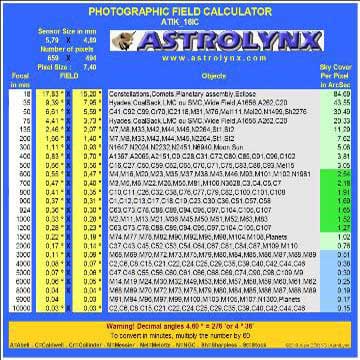
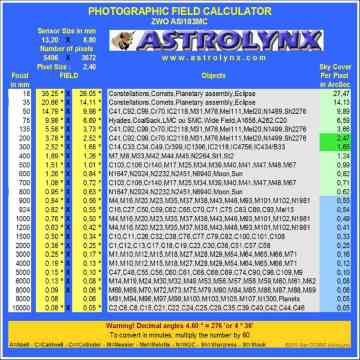
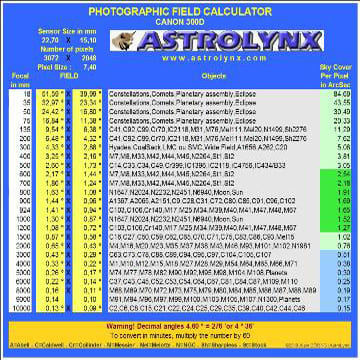
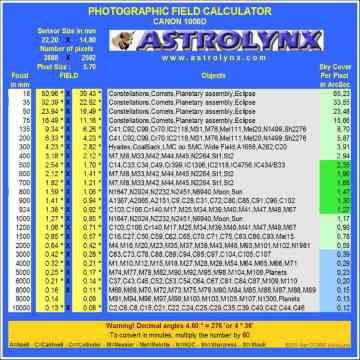
Choice of field, sensor, optics, focal length, with reducer, barlow, or not, and depending on the object to be imaged.